
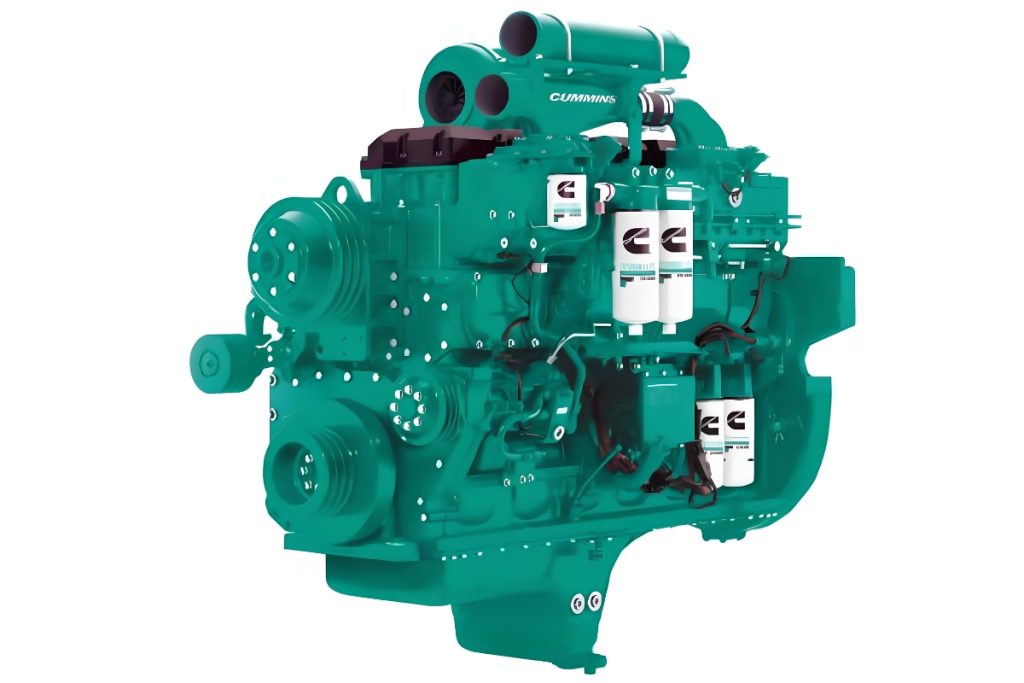
909 kVA Cummins Diesel Generator – QSK23G3
Prime-rated 909 kVA (1000 kVA standby) 60 Hz diesel generator set powered by a Cummins QSK23G3 engine. Leroy Somer TAL-A49-C alternator, DEIF SGC 420 controller, water-cooled. Supplied with Cummins IQA.
909kVA Cummins QSK23G3 Diesel Generator
The 909kVA Cummins QSK23G3 is a 60 Hz diesel generating set rated at 909 kVA (727 kW) prime and 1000 kVA (800 kW) standby at 1800 rpm, with a continuous base load rating of 729 kVA (583 kW). It pairs the Cummins QSK23-G3 engine with a Leroy Somer TAL-A49-C alternator and a DEIF SGC 420 controller, and is built for sites on 60 Hz supply. The engine is designed in ISO 9001 certified facilities and built to comply with CE requirements, and the set is supplied with Cummins Installation Quality Assurance (IQA).
Cummins QSK23G3: Quantum series engine with full authority electronic fuel control
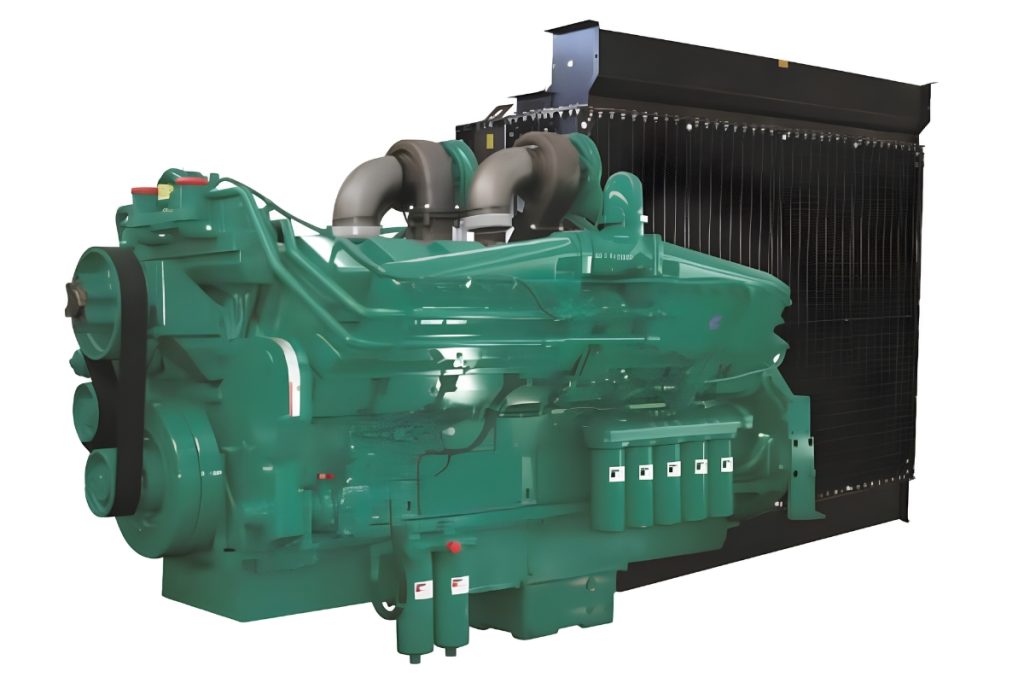
The QSK23-G3 is an in-line 6-cylinder, 23.1-litre, turbocharged engine from the Cummins Quantum series, with a 170 mm bore and stroke. Fuel is delivered by the Cummins High Pressure Injection (HPI) PT full authority electronic system, managed by a G-Drive Governor Control System (GCS) controller mounted off-engine in the genset control panel, which also provides an engine protection package. A CTT HX82 turbocharger and air-to-air charge cooling keep intake temperatures down, and the Coolpac cooling package holds 110 litres of coolant with a limiting ambient temperature of 55°C at 60 Hz. At 60 Hz the engine produces 809 kWm gross at prime and 895 kWm gross at standby.
Who is this for
Applications:
- Standby power for facilities on a 60 Hz supply
- Prime power for 60 Hz sites without a reliable grid connection
- Backup power with automatic mains failure changeover through the DEIF SGC 420
Industries:
- Oil and gas facilities on 60 Hz networks
- Mining and heavy extraction operations
- Large commercial buildings and campuses
- Water and wastewater treatment plants
- Manufacturing and process plants
- Construction and infrastructure projects needing temporary 60 Hz power
Who is this for
The CMTP909C is specified for projects that need around 900 kVA of prime power on a 60 Hz network from a single generating set. It suits electrical engineers, project managers and procurement teams working on industrial, commercial and infrastructure sites in 60 Hz markets, where the electronic fuel control of the Quantum series engine and the AMF capability of the DEIF SGC 420 are both useful. Typical buyers include EPC contractors, facilities engineers at large commercial or industrial sites, and operations teams at mining or oil and gas facilities running 60 Hz equipment.
Typical applications
- Providing 909 kVA prime power as the main generation source for a remote 60 Hz industrial site with no reliable grid connection.
- Supplying 1000 kVA standby power to a commercial building or campus on a 60 Hz supply where losing power to critical systems is not acceptable.
- Automatic mains failure (AMF) backup, with the DEIF SGC 420 starting the set and transferring load when the mains fails and handing it back once the mains returns.
- Standby power for a water or wastewater treatment plant where pumps and treatment equipment must keep running through a utility failure.
- Prime power during the construction phase of an infrastructure project on a 60 Hz network.
- Scheduled auto exercise runs, using the SGC 420 to start and test the set on a timetable without manual intervention.
- Base load continuous power (COP rating: 729 kVA / 583 kW) for a process plant running the set at constant load for unlimited hours.
- Temporary power during planned grid maintenance on a 60 Hz distribution network.
How to install and commission
Step 1: Confirm the complete generator set footprint and weight with CMT Power before civil design; for reference, the bare QSK23-G3 engine measures 2,976 x 1,656 x 1,964 mm and weighs 3,245 kg dry. Allow at least one metre of maintenance clearance on all sides and have a structural engineer specify the mounting pad and vibration isolation for the installed weight.
Step 2: Install vibration isolation mounts between the base frame and the slab. Connect the exhaust to the silencer (9 dB industrial or 25 dB residential, delivered loose) using flexible bellows to decouple vibration from the building, with allowance for thermal expansion.
Step 3: Connect the bulk fuel supply, day tank, primary and secondary filtration and fuel return line. Size the supply pipework for at least 212 L/h, the full standby consumption at 60 Hz, and prime the fuel system fully before the first start.
Step 4: Confirm the alternator winding connection matches the site voltage before energising; the Leroy Somer TAL 049 range is reconnectable across 380 V to 480 V at 60 Hz. Connect the output to the site distribution through the main circuit breaker (4-pole breaker available as an option), and connect neutral and earth to the site earthing design.
Step 5: Fill the Coolpac cooling system to its 110-litre capacity with a 50% ethylene glycol / 50% water mixture. Check all hose connections, recheck the level at operating temperature, and test the water jacket heater (if fitted) before relying on the set for a cold start.
Step 6: Commission the DEIF SGC 420 using DEIF Smart Connect software or the front panel: set the AMF parameters, generator and engine protection thresholds (under/over voltage, under/over frequency, overload, reverse power), start and stop sequencing, and RS-485 Modbus, USB or CAN communication if the site needs remote monitoring.
Step 7: Run a staged load test: start unloaded, then apply 25%, 50%, 75% and 100% of rated load, recording voltage, frequency, fuel consumption, coolant temperature and oil pressure at each step. Verify load acceptance against NFPA 110 and issue a load test certificate on completion.
Load sizing guidance
Calculate the total connected load in kW and divide by the site power factor (typically 0.8) to get the kVA requirement. Add at least 20% margin above the running load to cover load steps and avoid sustained operation above 80% of rated capacity. Motors started direct-on-line draw several times their running current, so calculate the peak kVA during the largest motor start, not just the running load. Excitation choice matters here: Leroy Somer’s data for the TAL 049 C at 400 V shows about 1,920 kVA of motor starting capability with AREP+ excitation against about 1,390 kVA with standard SHUNT excitation, so the optional PMG/AREP+ excitation is worth considering for heavy motor loads. For prime power use, keep the load between 30% and 80% of the prime kW rating; long periods below 30% load risk wet stacking and should be managed with load control or a load bank.
Common specification errors
- Specifying to standby kVA for a continuous prime power application: The standby rating (1000 kVA) is for emergency use only. Running the set at its standby rating as a prime power source will overload the engine, invalidate the warranty and shorten its service life.
- Ordering this set for a 50 Hz site: The 909 kVA prime / 1000 kVA standby ratings apply at 60 Hz / 1800 rpm. At 50 Hz / 1500 rpm Cummins rates the QSK23-G3 at 810 kVA prime and 900 kVA standby, so a 50 Hz project needs a different specification.
- Choosing the wrong output voltage: Leroy Somer rates the TAL 049 C at 60 Hz for 815 kVA continuous at 380 V, 940 kVA at 440 V and 1,025 kVA at 480 V (class H). The 909 kVA prime rating is therefore met at 440 V and 480 V; a 380 V, 60 Hz site would need the alternator selection confirmed with CMT Power.
- Underestimating motor starting current: Starting several large pumps, compressors or chillers at once without soft starters or variable speed drives can cause a deep voltage dip and trip the generator protection.
- Ignoring altitude and temperature derating: The engine’s limiting ambient temperature is 55°C at 60 Hz, and the alternator ratings apply up to 1,000 m altitude. Sites that are hotter or higher will see reduced output; confirm the derated figures with CMT Power before specifying.
- Leaving the transfer arrangement out of the design: The SGC 420 can run automatic mains failure changeover, but only with correctly rated and wired mains and generator breakers. Include the transfer switch or breaker arrangement in the electrical design from the start.
Safety and regulatory considerations
Install the set in line with ISO 8528 for generating set performance and IEC 60034 for the alternator. The Leroy Somer TAL 049 range meets IEC 60034, NEMA MG 1.32-33, ISO 8528-3 and CSA C22.2 n°100-14, with UL 1446 and UL declarations available, which is relevant for 60 Hz projects in North American markets. For emergency power systems, NFPA 110 sets the requirements for start time, load acceptance and periodic testing. DEIF recommends protecting the genset and mains breaker relays against surges as described in IEC 61000-4-5. The alternator is rated IP23 and the SGC 420 front panel IP65, so an outdoor open set needs a suitably rated enclosure. The QSK23-G3 is a non-regulated engine build with no emissions certification; confirm the emissions rules that apply to your site, particularly for mobile or temporary use.
Maintenance schedule
| Interval | Service Task |
|---|---|
| Daily (before start) | Check engine oil level (103 L capacity), coolant level (110 L system), fuel level, battery voltage and DEIF SGC 420 status indicators |
| Weekly | Inspect for fuel, oil and coolant leaks; check the air filter restriction indicator; verify water jacket heater operation; test the manual start sequence |
| 250 hours | Engine oil and spin-on full-flow filter change; replace spin-on fuel filters and water separator; inspect drive belts and hoses |
| 500 hours | Full coolant system inspection; turbocharger inspection; battery capacity test; check alternator voltage regulation against the AVR specification |
| Annual | Full service to the Cummins schedule; load bank test to at least 75% of rated load; review SGC 420 protection settings and software version |
| 2 years | Drain and refill the coolant; full electrical insulation check; review maintenance records for warranty compliance; plan alternator bearing replacement (greased-for-life bearings) |
Frequently Asked Questions
Q: What is the difference between the prime power rating and the standby power rating on this generator?
The prime power rating (PRP) of 909 kVA / 727 kW is the output this set can supply for an unlimited number of hours per year to a varying load when it is the main power source. The standby rating (ESP) of 1000 kVA / 800 kW is for use during a utility failure only, with no overload allowed. The base load (continuous) rating of 729 kVA / 583 kW applies when the set runs at a constant load for unlimited hours. At prime rating, a 10% overload is available in line with ISO 3046. Using the standby rating for a prime power application will overload the engine, invalidate the warranty and shorten its life.
Q: Is this a 50 Hz or a 60 Hz generator?
This set is rated at 60 Hz, running at 1800 rpm. The 909 kVA prime and 1000 kVA standby ratings only apply at 60 Hz. At 50 Hz / 1500 rpm Cummins rates the same QSK23-G3 engine at 810 kVA prime and 900 kVA standby, so 50 Hz projects need a different specification.
Q: What kind of governor and fuel system does the QSK23G3 use?
The QSK23-G3 uses the Cummins High Pressure Injection (HPI) PT full authority electronic fuel system. It is managed by a G-Drive Governor Control System (GCS) controller mounted off-engine in the genset control panel, which also provides an engine protection package. Electronic fuel control gives more precise fuelling across the load range than a purely mechanical system.
Q: What output voltage is available?
The Leroy Somer TAL 049 range can be connected for 380 V to 480 V (and 208 V to 240 V) at 60 Hz. At the 909 kVA prime rating, the TAL-A49-C alternator is rated for the full output at 440 V and 480 V; at 380 V its continuous rating is 815 kVA, so a 380 V, 60 Hz site needs the alternator selection confirmed with CMT Power at the quotation stage.
Q: What is the fuel consumption of the QSK23G3 at different load levels?
At 60 Hz prime rating, fuel consumption is 189 L/h at 100% load, 139 L/h at 75% load, 97 L/h at 50% load and 56 L/h at 25% load. At full standby rating it is 212 L/h, and at the continuous (COP) rating it is 149 L/h. Use the standby figure for day tank and supply pipework sizing. Fuel should meet EN 590 or an equivalent national specification to protect the HPI fuel system.
Q: What are the recommended service intervals for the QSK23G3 engine?
The QSK23-G3 uses spin-on fuel filters with a water separator and a spin-on full-flow lube oil filter, with a lube oil capacity of 103 litres. Oil and filter changes typically follow the Cummins schedule of every 250 running hours or annually, whichever comes first, with coolant servicing every two years or at the interval for the coolant used. An annual load bank test to at least 75% of rated load helps prevent wet stacking and checks governor and protection operation.
Q: What does the DEIF SGC 420 controller do?
The DEIF SGC 420 is a single genset controller that handles island operation, automatic mains failure (AMF), remote start/stop, cyclic running and scheduled auto exercise. It provides generator, engine and mains protection, including under/over voltage, under/over frequency, overload, reverse power, phase reversal and unbalanced load. It communicates over RS-485 Modbus, USB and CAN, is configured through DEIF Smart Connect software or the front panel, and is rated IP65 at the front with an operating range of -20°C to +65°C.
Q: What certifications does this generator carry, and what about emissions?
The engine is built to comply with CE requirements and is designed in ISO 9001 certified facilities, and the set comes with Cummins Installation Quality Assurance (IQA) and accepts load in line with NFPA 110. The Leroy Somer alternator range meets IEC 60034, NEMA MG 1.32-33 and ISO 8528-3, with UL declarations available. The QSK23-G3 is a non-regulated engine build with no emissions certification, so check the emissions rules for your site, particularly for mobile or temporary use.
Q: Can CMT Power deliver and commission a 909kVA generator to a live project with a critical power timeline?
CMT Power supplies generating sets to live projects and arranges shipping and logistics internationally. For projects with a fixed commissioning date, contact the CMT Power engineering team at enquiries@cmtpower.com or +44 (0)330 700 3377 to confirm availability, lead time and the commissioning and load testing support available for your site.
Q: What warranty and options are available for the QSK23G3 generating set?
The warranty is five years for standby applications and two years for prime power applications. Options include a 220 V water jacket heater, a sound attenuated canopy, an alternator heater, a PMG excitation kit and a 4-pole main circuit breaker. Silencers are available with 9 dB (industrial) or 25 dB (residential) attenuation and are delivered loose.
Have a project that needs power?
Our team can advise on the right generator for your application, capacity requirements and delivery timeline.