

365 kVA Cummins Diesel Generator – NTA855G4
Prime-rated 365 kVA (400 kVA standby) 50 Hz diesel generator set powered by a Cummins NTA855G4 engine. Stamford S4L1D-E41 Wdg.311 alternator, Deep Sea controller, water-cooled.
365kVA Cummins NTA855G4 Diesel Generator
The 365kVA Cummins NTA855G4 is a 50 Hz diesel generating set rated at 365 kVA (292 kW) prime and 400 kVA (320 kW) standby at 1500 rpm, with a continuous base load rating of 306 kVA (245 kW). It pairs the Cummins NTA855G4 engine with a Stamford S4L1D-E41 Wdg.311 alternator and a Deep Sea controller, with a 380V (220/380V) three-phase output. It is supplied as a complete, factory-assembled generating set with the engine, alternator and control panel mounted on a common base frame.
Cummins NTA855G4: 14-litre 6-cylinder in-line engine
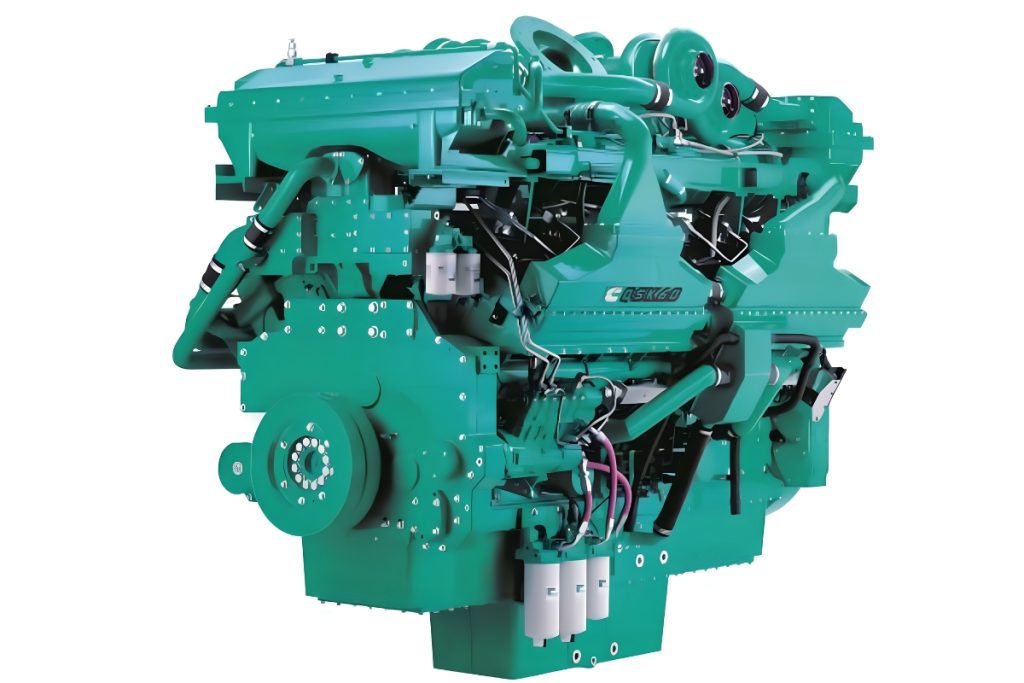
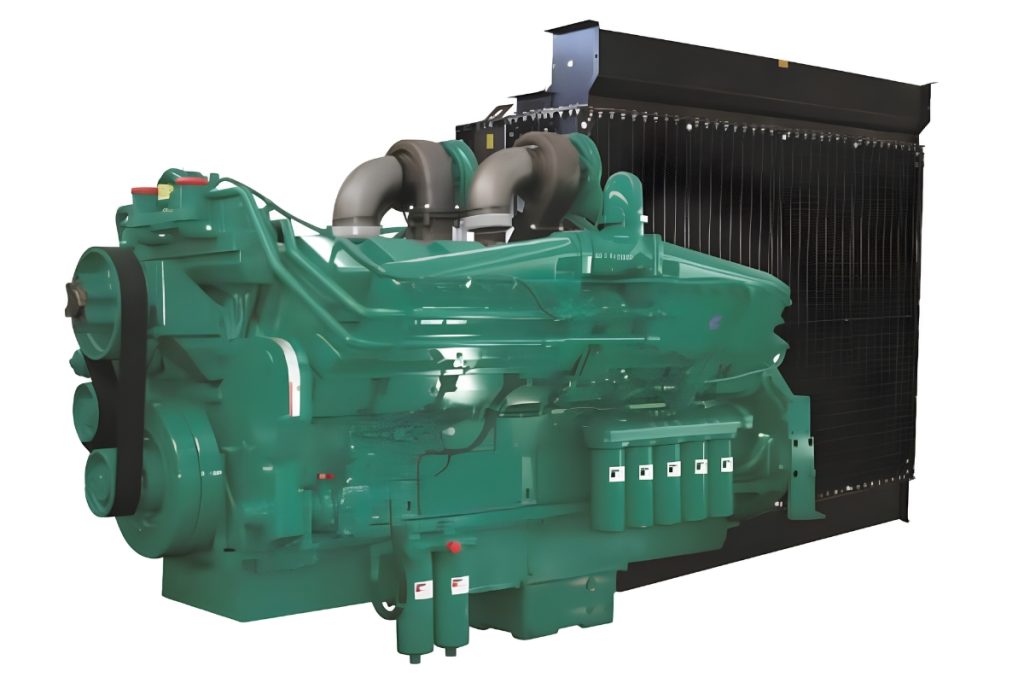
The NTA855G4 is a 14-litre, 6-cylinder in-line engine with a bore and stroke of 140 × 152 mm, turbocharged (cooling system design listed by Cummins as JWAC, jacket water aftercooled). 14-litre six-cylinder engine with Cummins PT self-adjusting fuel system, camshaft-actuated injectors and a built-in dual-flyweight governor for independent overspeed protection; dual spin-on fuel filters. Alloy cast-iron block with replaceable wet liners; each alloy cast-iron cylinder head serves two cylinders. The limiting ambient temperature for the cooling system is 54.7°C. Lube oil capacity is 38.6 litres and the cooling system holds 45 litres.
Who is this for
Applications:
- Standby power for large commercial and industrial facilities
- Prime power for remote or weak-grid industrial sites
- Backup power for hospitals, process plants and critical loads
Industries:
- Manufacturing and process plants
- Mining and quarrying
- Oil and gas facilities
- Healthcare campuses
- Water and wastewater treatment
- Construction and infrastructure projects
Who is this for
The 365 kVA Cummins NTA855G4 is specified for large loads on 50 Hz supply where a single generating set needs to carry a whole building or process. It serves electrical engineers, project managers and procurement teams at industrial sites, large commercial and healthcare facilities, and infrastructure projects.
Typical applications
- Providing 365 kVA prime power as the main source for a site without a reliable grid connection.
- Supplying 400 kVA standby power to a facility on 50 Hz supply during a utility outage.
- Automatic mains failure (AMF) backup, with the Deep Sea starting the set and transferring load when the mains fails.
- Backing up a process plant or large building where a power cut would stop production or critical services.
- Prime power during the construction phase of an infrastructure project.
- Supporting a site during planned grid maintenance or connection upgrades.
- Base load continuous power (COP rating: 306 kVA / 245 kW) for a site running the set at constant load for unlimited hours.
- Temporary power for events or short-term projects where the grid connection is limited.
How to install and commission
Step 1: Confirm the complete set footprint and weight with CMT Power before civil design; for reference, the NTA855G4 engine package measures 2,055 × 990 × 1,535 mm and weighs 1,410 kg dry. Allow at least one metre of clearance on all sides for maintenance and airflow.
Step 2: Fit vibration isolation between the base frame and the foundation, and connect the exhaust to the silencer using flexible bellows, routed away from air intakes and occupied areas. Silencer supplied: industrial silencer, 9 dB attenuation; residential silencer, 25 dB attenuation, delivered loose.
Step 3: Connect the fuel supply, filtration and return line, sizing the supply for at least 84 L/h, the highest published consumption for this set. Prime the fuel system fully before the first start.
Step 4: Check the alternator connection matches the site voltage (380V (220/380V), 50 Hz) and connect the output to the distribution board through a correctly rated main circuit breaker, with neutral and earth connected to the site earthing design.
Step 5: Fill the cooling system to its 45-litre capacity with a 50/50 mix of ethylene glycol and water, check all hoses, and confirm the level again at operating temperature.
Step 6: Commission the Deep Sea control module: set the automatic start parameters, engine and generator protection limits and start/stop timers, and confirm the alarms and shutdowns work.
Step 7: Run a staged load test at 25%, 50%, 75% and 100% of rated load, recording voltage, frequency, oil pressure and coolant temperature at each step, and confirm load acceptance against NFPA 110.
Load sizing guidance
Add up the connected load in kW and divide by the power factor (typically 0.8) to get the kVA requirement, then add at least 20% margin so the set does not run above about 80% of its rating for long periods. Motors started direct-on-line draw several times their running current, so check the peak kVA when the largest motor starts, not just the running load. For prime power, aim to keep the load between 30% and 80% of the 365 kVA prime rating; long periods at very light load can cause wet stacking and should be avoided with load management or a load bank.
Common specification errors
- Using the standby rating for continuous duty: The 400 kVA standby rating is for emergency use during a mains failure. A set that runs every day as the main power source should be sized on its 365 kVA prime rating.
- Ordering for the wrong frequency: This set is rated at 50 Hz / 1500 rpm. A site on 60 Hz supply needs a different specification, and ratings change with speed.
- Mixing up the voltage: Confirm the site voltage (380V (220/380V)) and phase arrangement before ordering, so the alternator is connected and the AVR set correctly at the factory.
- Underestimating motor starting current: Starting several large motors at once without soft starters or variable speed drives can cause a deep voltage dip and trip the generator protection.
- Ignoring altitude and temperature derating: The cooling system’s limiting ambient temperature is 54.7°C. Hotter or higher sites see reduced output, so confirm the derated figures with CMT Power before specifying.
- Leaving the transfer arrangement out of the design: The Deep Sea can run automatic mains failure changeover, but only works with correctly rated and wired mains and generator breakers or a transfer switch. Include it in the electrical design from the start.
Safety and regulatory considerations
Install the set in line with ISO 8528 for generating set performance and IEC 60034 for the alternator, and follow local wiring regulations for the connection to the site supply. For emergency power systems, NFPA 110 sets the requirements for start time, load acceptance and periodic testing. Keep the exhaust away from air intakes and occupied spaces, provide adequate ventilation for cooling and combustion air, and store fuel in a bunded tank where required. An open set installed outdoors needs a suitable enclosure for weather protection. Emissions: Non-Regulated. Check the rules that apply to your site, particularly for mobile or temporary use.
Maintenance schedule
| Interval | Service Task |
|---|---|
| Daily (before start) | Check engine oil level (38.6 L capacity), coolant level (45 L system), fuel level, battery voltage and the Deep Sea status indicators |
| Weekly | Inspect for fuel, oil and coolant leaks; check the air filter restriction indicator; run the set off load briefly if it is on standby duty |
| Engine manufacturer’s oil service interval | Change engine oil and filters; replace fuel filters and drain the water separator; inspect drive belts and hoses |
| Every 6 months | Check battery condition and charging; clean the radiator core; check alternator and control panel connections |
| Annual | Full service to the engine manufacturer’s schedule; load bank test at 75% or more of rated load; review controller protection settings |
| Every 2 years | Drain and refill the coolant; electrical insulation check on the alternator; review maintenance records for warranty compliance |
Frequently Asked Questions
Q: What is the difference between the prime power rating and the standby power rating on this generator?
The prime rating of 365 kVA (292 kW) is the output the set can supply for unlimited hours to a varying load when it is the main power source. The standby rating of 400 kVA (320 kW) is for emergency use during a mains failure, with no overload allowed. The base load (continuous) rating of 306 kVA (245 kW) applies when the set runs at a constant load for unlimited hours. Running a set on its standby rating as a prime power source overloads the engine and shortens its life.
Q: Is this a 50 Hz or a 60 Hz generator?
This set is rated at 50 Hz, running at 1500 rpm, with a 380V (220/380V) three-phase output. The ratings above apply at 50 Hz; a 60 Hz site needs a different specification.
Q: What fuel system and governor does the NTA855G4 use?
The NTA855G4 uses direct injection, Cummins PT self-adjusting fuel system with camshaft-actuated injectors. The PT fuel system has an integral dual-flyweight governor that provides overspeed protection independent of the main governor.
Q: Which alternator is fitted, and what voltage does it supply?
The set uses a Stamford S4L1D-E41 Wdg.311 alternator: single bearing, brushless and self-excited, with class H insulation, an AS440 AVR, and IP23 protection. It is connected for 380V (220/380V) at 50 Hz, with voltage regulation of ±1%.
Q: What is the fuel consumption of the NTA855G4 at different loads?
At prime rating, fuel consumption is 76 L/h at 100% load, 57 L/h at 75%, 39 L/h at 50% and 21 L/h at 25%. At full standby rating it is 84 L/h. At the continuous rating it is 65 L/h. Fuel should meet EN 590 or an equivalent national diesel specification.
Q: What are the recommended service intervals for the NTA855G4?
Follow the engine manufacturer’s service schedule: oil and filter changes, fuel filter replacement and water separator draining at each service, with coolant replacement every two years or as the coolant type requires. Lube oil capacity is 38.6 litres. An annual load bank test at 75% or more of rated load helps prevent wet stacking on lightly loaded standby sets.
Q: What does the Deep Sea controller do?
The Deep Sea automatic start control module monitors the engine and alternator, starts and stops the set, and shuts it down on faults such as low oil pressure, high coolant temperature and overspeed. Confirm the exact module model and its communication options with CMT Power at the quotation stage.
Q: What certifications does this generator carry, and what about emissions?
The set carries: CE certification available; Installation Quality Assurance (IQA) from Cummins; Supplier states the genset accepts load as per NFPA 110; Engine designed in ISO 9001 certified facilities and manufactured in ISO 9001 or ISO 9002 certified facilities. Emissions: Non-Regulated. Check the emissions rules for your site, particularly for mobile or temporary use.
Q: Can CMT Power deliver and commission a 365kVA generator to a live project?
CMT Power supplies generating sets to live projects and arranges shipping and logistics internationally. For projects with a fixed date, contact the CMT Power team at enquiries@cmtpower.com or +44 (0)330 700 3377 to confirm availability, lead time and the commissioning and load testing support for your site.
Q: What warranty and options are available?
Warranty: 5 years for standby application; 2 years for prime application. Options include: Water jacket heater 220V; Sound attenuated canopy; Alternator heater; PMG kit; 4-pole main circuit breaker. Silencer: Industrial silencer, 9 dB attenuation; residential silencer, 25 dB attenuation, delivered loose.
Have a project that needs power?
Our team can advise on the right generator for your application, capacity requirements and delivery timeline.