
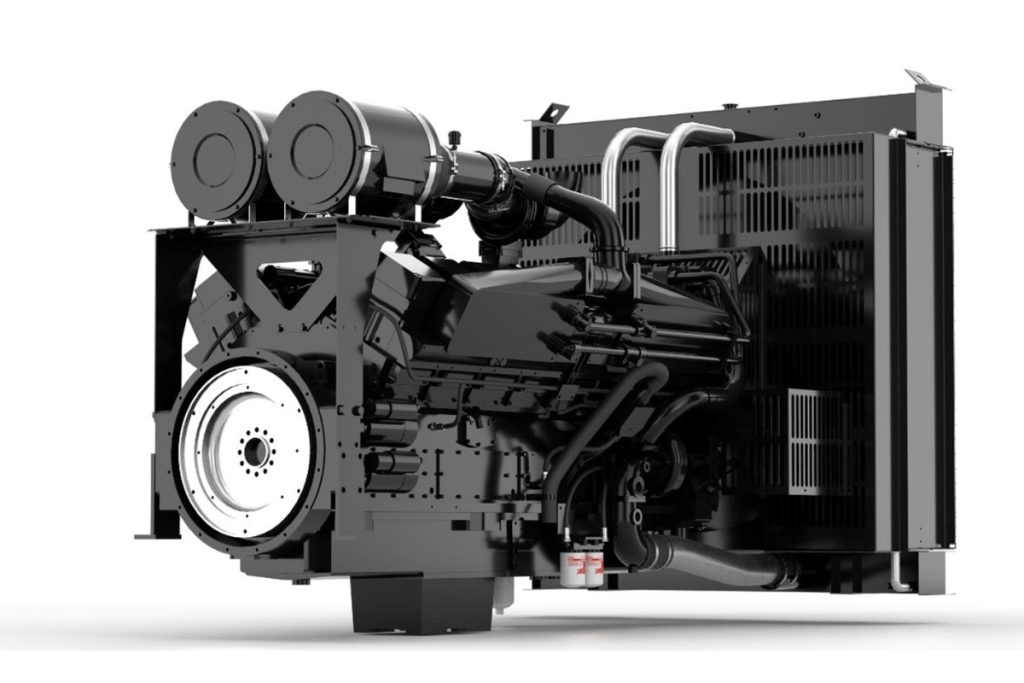
1400 kVA Cummins Diesel Generator – KTA50G8
1416 kVA prime / 1675 kVA standby diesel generator set powered by a Cummins KTA50-G8 16-cylinder turbocharged and aftercooled engine. Stamford brushless alternator, Deep Sea control, water-cooled. CE certified, ISO 9001, NFPA 110.
1400 kVA Cummins KTA50-G8: fuel-optimised power for prime and standby duty
The CMT Power CMTP1400C is a 1416 kVA prime / 1675 kVA standby diesel generating set built around the Cummins KTA50-G8, a 50.3-litre, 16-cylinder turbocharged and aftercooled V-configuration engine from the same KTA50 family used across CMT Power’s mid-to-high kVA range. Rated to a limiting ambient temperature of 48°C, the KTA50-G8 also carries a continuous base load rating of 1295 kVA (1036 kW) for applications running at constant, unchanging output. The unit is manufactured in ISO 9001 certified facilities, CE marked, and supplied with Cummins Installation Quality Assurance (IQA).
Cummins KTA50-G8: Coolpac cooling and PT fuel system
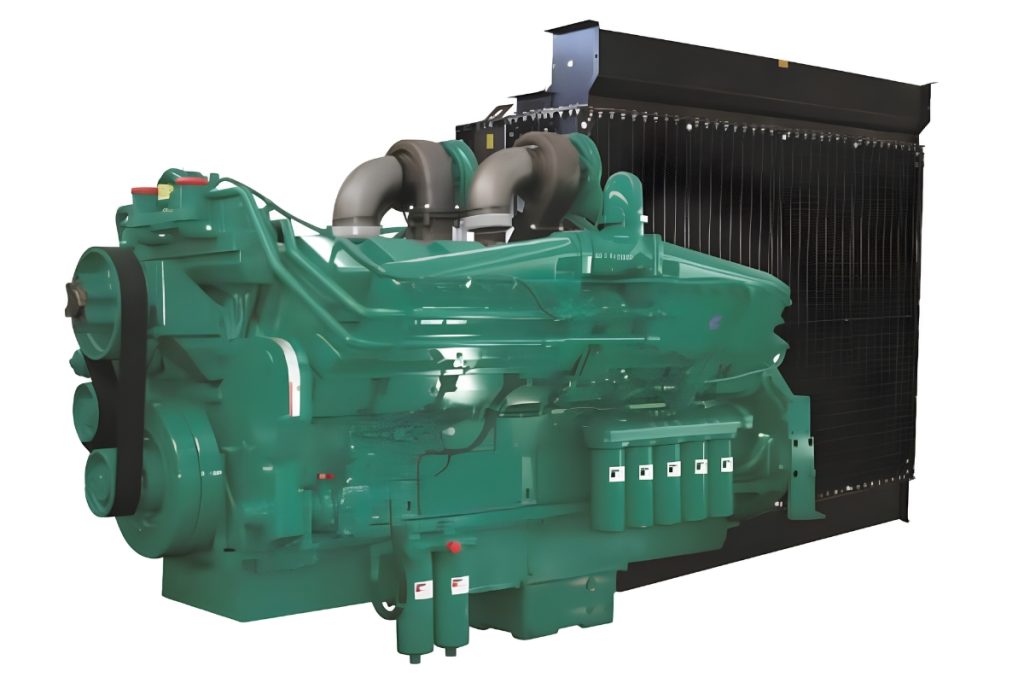
The KTA50-G8 uses the same two-pump, two-loop Coolpac cooling architecture found across the KTA50 range, with 496 litres of coolant capacity maintaining separate thermal circuits for the engine jacket and integral aftercoolers. Fuel injection is handled by the Cummins PT direct injection system with dual spin-on paper element fuel filters and an integrated water separator. A 177-litre lube oil capacity with full-flow spin-on filter and a 35-amp battery charging alternator on a 24V negative-ground starting system complete the engine specification.
The alternator is a Stamford brushless, self-excited, self-regulated unit, insulation class H, rated at 380/220V, 3-phase, 4-wire, power factor 0.8, maintaining output voltage within ±1% across varying loads. Control is via a Deep Sea automatic start module with engine monitoring and protection. Optional 4-pole main circuit breaker, sound-attenuated canopy enclosure, water jacket heater, alternator heater, and PMG kit are available depending on the project.
CE certified, ISO 9001 designed and manufactured, and load-acceptance performance compliant with NFPA 110. Warranty: 5 years for standby applications, 2 years for prime power applications, backed by the worldwide Cummins G-Drive service network.
Who is this for
Applications:
- Standby power for data centres, hospitals, and large commercial buildings
- Prime power for remote sites, off-grid installations, and mining operations
- Continuous base-load power for industrial process plants requiring constant output
Industries:
- Oil and gas midstream and downstream operations
- Mining and mineral extraction
- Manufacturing and heavy industry
- Data centres and telecommunications
- Healthcare and critical facilities
- Construction, events, and temporary power
Who is this for
The CMTP1400C is suited to operators requiring dependable, mid-range prime or standby power in industrial, infrastructure, and commercial settings, with a continuous base-load rating (1295 kVA) available where constant, uninterrupted output is required rather than a varying load profile. Its KTA50-G8 engine, economical fuel consumption, and wide ambient temperature tolerance make it a practical choice wherever long-term reliability and cost-effectiveness are the priority.
Typical applications
- Providing 1416 kVA prime power as the primary generation source for a remote industrial site, mining compound, or off-grid facility where grid connection is unavailable or unreliable.
- Supplying 1675 kVA standby emergency power to a large commercial building, hospital, or data centre where continuity of critical systems during a utility outage is essential.
- Delivering continuous base-load power (1295 kVA / 1036 kW) to an industrial manufacturing facility or process plant operating at constant output in an off-grid or weak-grid location.
- Serving as backup generation for a mid-size data centre or telecoms facility, integrated into the site’s low-voltage (380/220V) switchgear and automatic transfer switch.
- Acting as the standby power source for a water or wastewater treatment plant where continuous operation of pumping and treatment equipment is required under utility failure conditions.
- Delivering prime power during the construction phase of an infrastructure or civil works project where grid supply is unavailable across the active site.
- Operating in a load-sharing parallel configuration with a second CMTP1400C or equivalent Cummins generating set via the Deep Sea paralleling controller to provide redundant N+1 generation.
- Supporting a utility-scale or grid-support temporary power scheme during scheduled maintenance or infrastructure works affecting substation or distribution network capacity.
How to install and commission
Step 1: Prepare the installation site to accommodate the generator footprint of 3,725 x 2,000 mm with a minimum 1-metre maintenance clearance on all sides. Engineer the floor slab or base frame to carry a minimum dry weight of 6,580 kg plus dynamic load allowance.
Step 2: Install vibration isolation mounts or anti-vibration pads between the genset base frame and the mounting surface to prevent operational vibrations from transmitting into the building or structure.
Step 3: Connect the two-loop cooling system. The KTA50-G8 requires separate radiators or heat exchangers for the engine jacket circuit and the aftercooler circuit. Size each loop to Cummins Coolpac specification: coolant capacity 496 L, fan power 32 kWm, cooling airflow 28.8 m³/s, at up to 48°C ambient.
Step 4: Route the exhaust system with the selected silencer (9 dB industrial or 25 dB residential attenuation, supplied loose), ensuring back-pressure remains within engine limits. Terminate exhaust safely away from air intakes and occupied areas.
Step 5: Connect the fuel supply using diesel fuel meeting Cummins specification. Confirm dual spin-on fuel filters and the integrated water separator are correctly installed before commissioning.
Step 6: Wire the genset to the site distribution system via appropriate switchgear. The optional 4-pole main circuit breaker can be specified on the power panel. Ensure voltage, phase sequence, and earthing comply with local regulations and the alternator’s rated output of 380/220V, 3-phase, 4-wire.
Step 7: Commission the Deep Sea control module, configure engine protection thresholds, and carry out a no-load run followed by a stepped load test to confirm stable voltage and frequency regulation within ±1%.
Load sizing guidance
To size correctly, calculate total connected load in kW, then divide by the site power factor (typically 0.8) to determine required kVA. Apply a minimum 20% margin above the calculated running load to accommodate transient load steps and to avoid sustained operation above 80% rated capacity. For loads containing large electric motors (pumps, compressors, chillers), apply a motor starting current multiplier of 2.5 to 6 times running current (depending on starting method) to calculate the peak kVA demand during motor start; the generator must absorb this starting current without unacceptable voltage dip. Where the load is genuinely constant rather than varying, the continuous power rating (1295 kVA / 1036 kW) gives a lower but sustainable output for unlimited-hours operation at fixed load.
Common specification errors
- Specifying to standby kVA for a continuous prime power application: The standby rating (1675 kVA) is limited to emergency use only during utility failure; applying it as a prime power rating will result in engine overloading, warranty invalidation, and significantly reduced service life.
- Confusing prime and continuous ratings: The prime rating (1416 kVA) allows for a varying load with a 10% overload margin, while the continuous rating (1295 kVA) is lower and intended for a genuinely constant load with no overload allowance; using the wrong rating for the load profile will either under-specify capacity or shorten engine life.
- Underestimating motor starting current: Large pumps, compressors, or process motors starting across-the-line draw 5 to 6 times running current; even at 1416 kVA, simultaneous starting of multiple large motor loads without soft-starters or variable speed drives can cause significant voltage dip and potential generator protection trip.
- Ignoring altitude and temperature derating: Output ratings are stated at standard conditions (sea level, 48°C limiting ambient per the Cummins specification). At high-altitude or high-ambient-temperature sites, available output will be reduced; confirm corrected output with CMT Power’s technical team before committing to specification.
- Omitting ATS design from the project scope: A standby generator without a correctly specified and commissioned automatic transfer switch cannot guarantee automatic power restoration on mains failure; ATS specification must be integrated into the electrical design from the start of the project.
- Overlooking two-loop cooling requirements: The KTA50-G8’s Coolpac system requires separate radiator or heat exchanger circuits for the engine jacket and aftercooler; specifying a single-loop cooling arrangement will cause inadequate aftercooling and reduced engine performance.
Safety and regulatory considerations
This generating set must be installed in compliance with BS 7698 / ISO 8528 for generating set performance and IEC 60034 for alternator ratings. Load acceptance complies with NFPA 110 requirements applicable to healthcare and emergency power system projects. All LV cabling, switchgear, protective devices, and earthing must comply with applicable national wiring regulations for the 380/220V, 3-phase, 4-wire output. Where this generator is deployed in a hazardous area (ATEX Zone 1 or Zone 2), additional engine and alternator specifications are required; consult CMT Power before specifying for any hazardous area installation. For outdoor open-set installation, an appropriately IP-rated enclosure must be provided; the base generating set does not carry an IP rating independent of its housing. The optional sound-attenuated canopy should be specified where the installation is near noise-sensitive occupied areas.
Maintenance schedule
| Interval | Service Task |
|---|---|
| Daily (before start) | Check engine oil level (177 L capacity), coolant level (496 L system), fuel level, battery voltage, and Deep Sea control module status indicators |
| Weekly | Inspect for fuel, oil, and coolant leaks; check air filter restriction indicator; verify water jacket heater operation (if fitted); test manual start sequence |
| 250 hours | Engine oil and filter change (spin-on full-flow filter); dual fuel filter and water separator replacement; inspect drive belts and hoses |
| 500 hours | Full coolant system inspection across both cooling loops; injector check; turbocharger inspection; battery condition test; verify Stamford alternator excitation and voltage regulation (±1%) |
| Annual | Full service per Cummins G-Drive schedule; load bank test to minimum 75% rated load; coolant flush and refill assessment; review Deep Sea control module protection settings and firmware |
| 2 years | Coolant system drain and full refill; full electrical insulation check; review and update all maintenance records for warranty compliance |
Frequently Asked Questions
Q: What is the difference between the prime, standby, and continuous power ratings on this generator?
The prime power rating (PRP) of 1416 kVA / 1133 kW is the maximum output this generator can deliver to a varying load for unlimited hours per year, with 10% overload capability available for up to 1 hour in 12. The standby rating (ESP) of 1675 kVA / 1340 kW is the peak output available during a utility power failure, applied to a varying load for the duration of the outage, and should not be used for continuous prime power service. The continuous rating (COP) of 1295 kVA / 1036 kW applies where the load is constant rather than varying, with no overload margin, and is intended for unlimited-hours operation at fixed output.
Q: What makes the KTA50-G8 engine suitable for demanding applications?
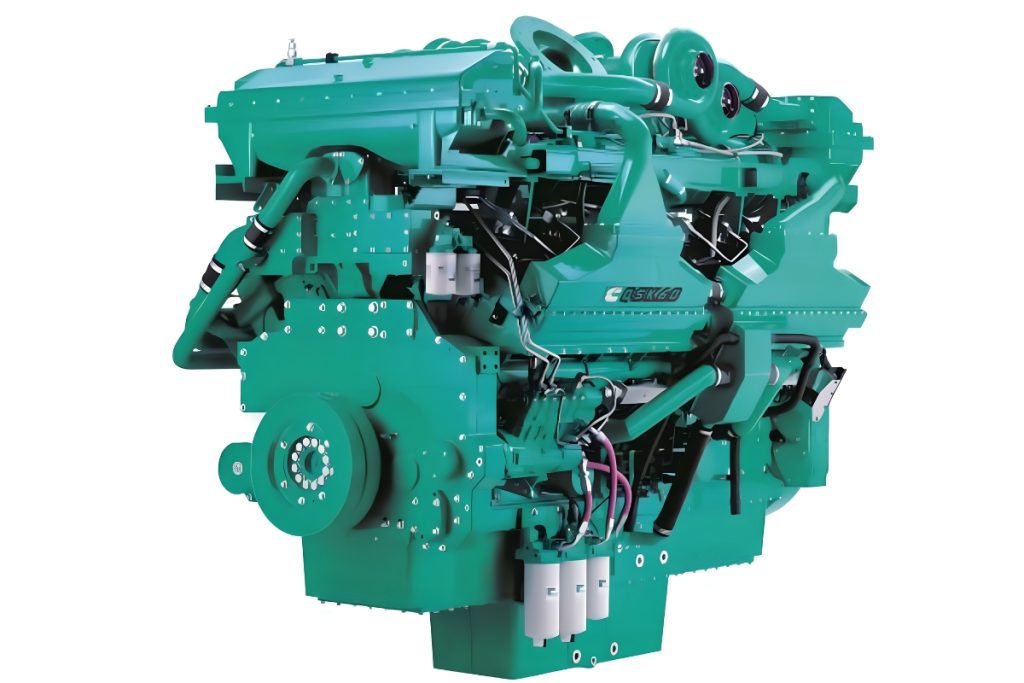
The Cummins KTA50-G8 is a 50.3-litre, 16-cylinder, 60° Vee turbocharged and low-temperature aftercooled engine built on the same KTA50 platform used across Cummins’ G-Drive range. Its two-pump, two-loop Coolpac cooling system maintains separate thermal circuits for the engine jacket and aftercoolers, delivering cooler, denser intake air for more complete combustion and lower internal stresses. Dual Ni-resist aluminium alloy pistons, ground and shaped to compensate for thermal expansion, keep a precise fit across all operating temperatures. The Cummins PT direct injection system and mechanical governor provide fuel delivery without dependence on electronic engine management.
Q: What is the fuel consumption at different load levels?
At prime power rating the KTA50-G8 consumes approximately 289 L/h at 100% load, 222 L/h at 75% load, 155 L/h at 50% load, and 82 L/h at 25% load. At full standby output (1340 kWe) consumption is approximately 345 L/h, and at 100% continuous output (1036 kWe) it is approximately 266 L/h. For fuel storage planning, size your tank for your required autonomy based on the expected average load; most prime-duty sites operate well below 100% load, reducing average consumption.
Q: What are the site and installation requirements?
The open-set generator measures 3,725 mm (L) × 2,000 mm (W) × 2,516 mm (H) and weighs 6,580 kg dry. Allow a minimum 1-metre clearance on all sides for ventilation and maintenance access. The KTA50-G8 requires a two-loop cooling arrangement, with separate provisions for the engine jacket and aftercooler circuits, and this must be planned into the installation from the outset. Rated output is achievable at ambient temperatures up to 48°C. For noise-sensitive or weather-exposed installations, the sound-attenuated canopy option is available.
Q: What certifications does this generator carry?
The CMTP1400C carries CE marking and is compliant with NFPA 110 load acceptance requirements. The engine is designed and manufactured in ISO 9001 certified facilities. CMT Power provides the Cummins Installation Quality Assurance (IQA) certification confirming the genset meets Cummins’ assembly and test standards.
Q: What warranty is provided?
CMT Power provides a 5-year warranty for standby applications and a 2-year warranty for prime power applications. The genset is supported globally by the Cummins G-Drive service network, providing access to genuine parts, technical support, and qualified service engineers worldwide.
Q: What optional extras are available?
Available options include: water jacket heater (220V) for cold-start readiness and pre-heating during standby periods; sound-attenuated canopy enclosure for weather and acoustic protection; alternator heater to prevent condensation build-up; PMG (Permanent Magnet Generator) kit for improved voltage regulation under non-linear loads; 4-pole main circuit breaker on the power panel; 9 dB industrial silencer or 25 dB residential-grade silencer (both supplied loose).
Q: What fuel system does the KTA50-G8 use, and why does it matter?
The KTA50-G8 uses the Cummins PT (Pressure-Time) direct injection system with mechanical governor control, a mechanically controlled fuel delivery system used across the KTA50 range for decades. Dual spin-on paper element fuel filters with an integrated water separator protect the injectors from contamination. Because the PT fuel system does not require electronic engine management, it holds up well in environments where ECU reliability is a concern, and service and calibration can be carried out by Cummins-trained mechanics worldwide without specialist diagnostic equipment.
Q: Can this generator be operated in parallel with other sets?
Yes. The CMTP1400C can be configured for parallel operation with appropriate synchronising controls. The Deep Sea control module supports synchronisation and load sharing functionality. Multiple CMTP1400C units operating in parallel can deliver scalable power for large facilities or sites where redundancy is required. Contact CMT Power to discuss synchronising panel design, protection relay specification, and load sharing control configuration for your application.
Q: How does the continuous power rating differ from the prime rating in practical terms?
The prime rating (1416 kVA) is intended for variable loads, allowing the generator to run at different output levels over time with a permitted overload margin. The continuous rating (1295 kVA) is lower and intended for a fixed, unchanging load, such as a process plant running at constant output around the clock, with no overload margin applied. Selecting the correct rating for your load profile affects both warranty terms and long-term engine wear; contact CMT Power’s technical team to confirm which rating applies to your project.
Have a project that needs power?
Our team can advise on the right generator for your application, capacity requirements and delivery timeline.