
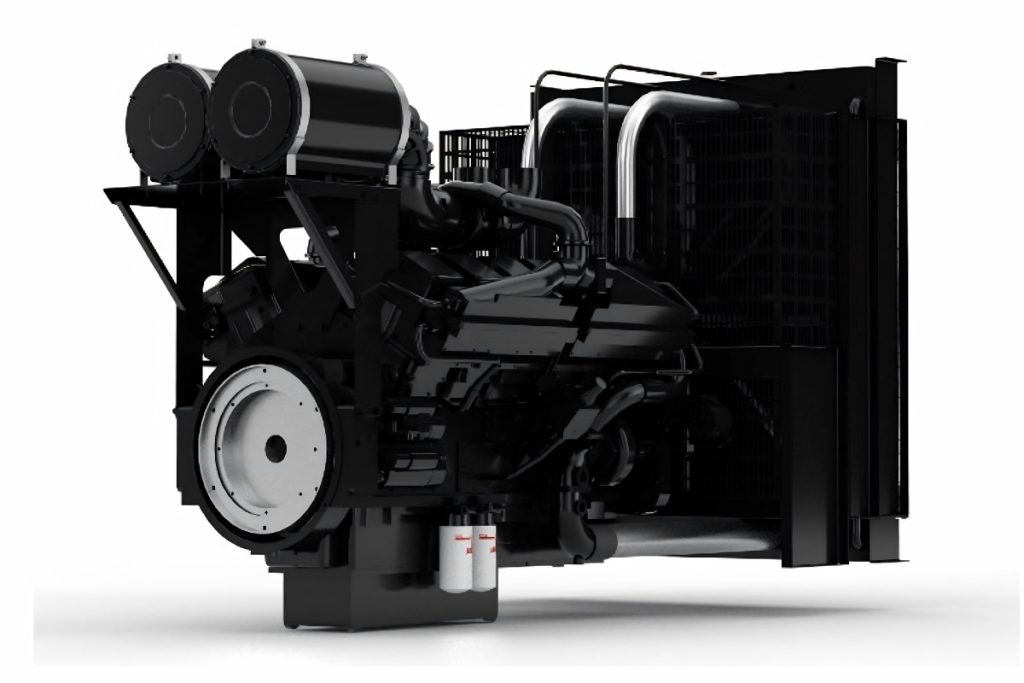
1000 kVA Cummins Diesel Generator – KTA38G5
Prime-rated 1000 kVA (1100 kVA standby) diesel generator set powered by a Cummins KTA38G5 engine. Leroy Somer alternator, DEIF SGC-420 control system, water-cooled. CE, ISO 9001, ISO 14001 and ISO 45001 designed and manufactured.
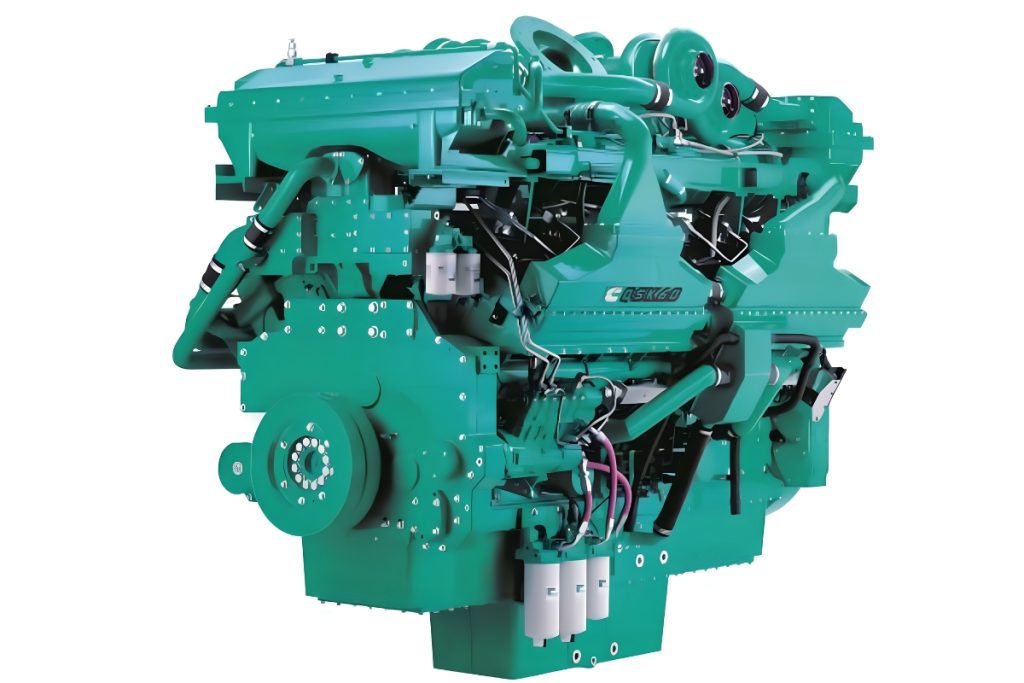
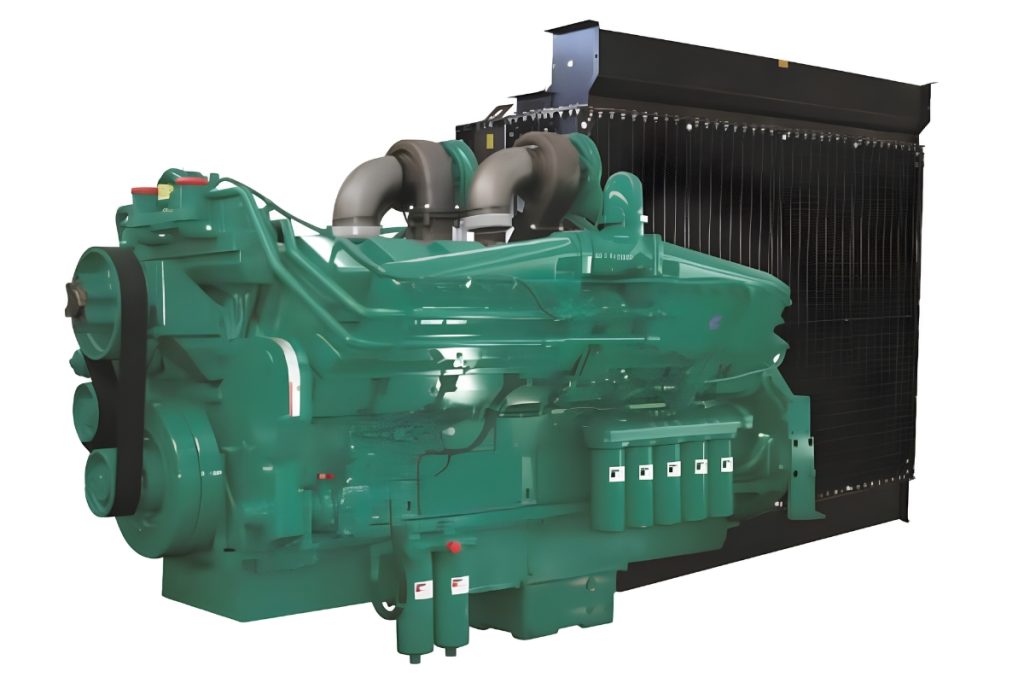
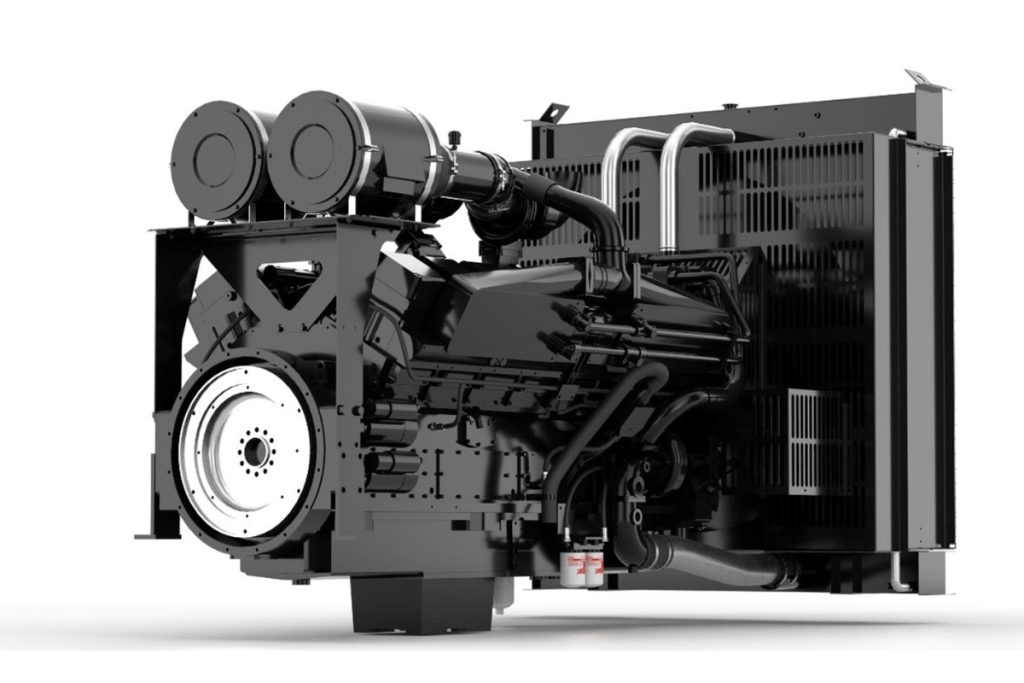
1000kVA Cummins KTA38G5 Diesel Generator
The 1000kVA Cummins KTA38G5 is a diesel generating set rated at 1000 kVA (800 kW) prime and 1100 kVA (880 kW) standby at 50 Hz, with a continuous base load rating of 750 kVA (600 kW) per Cummins’ engineering data for this engine. Configured with a 400V Leroy Somer alternator, this generating set is specified for industrial and commercial installations on standard low voltage distribution. Manufactured to ISO 9001, ISO 14001 and ISO 45001 and CE marked, it suits a broad range of standby and prime power applications.
Cummins KTA38G5: 12-cylinder PT fuel system with DEIF SGC-420 control
The KTA38G5 is a 12-cylinder, 37.8-litre, 60-degree Vee engine using the Cummins PT fuel system, a camshaft-actuated direct injection system with an integral mechanical dual-flyweight governor. Cooling is by Cummins Coolpac jacket water and charge air cooling, holding 210 litres of coolant, with a limiting ambient temperature of 50°C. The set is controlled by a DEIF SGC-420 single genset controller rather than the Deep Sea module used on some of CMT Power’s other ranges, giving automatic mains failure changeover, site battery monitoring, and RS-485/USB/CAN connectivity as standard.
Who is this for
Applications:
- Standby power for commercial and light industrial premises on standard low voltage supply
- Prime power for sites without a reliable grid connection
- Backup power for facilities that need automatic mains failure changeover
Industries:
- Commercial and retail premises
- Light and medium industrial facilities
- Healthcare and educational campuses
- Construction sites requiring temporary power
- Telecommunications and base transceiver station (BTS) sites
- Agriculture and food processing operations
Who is this for
The CMTP1000C is specified for standby and prime power needs in the sub-1100 kVA range on standard 400V low voltage distribution. It serves electrical engineers, facilities managers, and procurement teams at commercial, light industrial, and telecommunications sites where a DEIF-controlled generator with automatic mains failure changeover is required. Typical buyers include contractors specifying backup power for commercial buildings, facilities teams at healthcare or education campuses, and telecom operators needing site battery and shelter temperature monitoring alongside genset control.
Typical applications
- Providing 1000 kVA prime power as the primary generation source for a site with no reliable grid connection.
- Supplying 1100 kVA standby emergency power to a commercial or light industrial facility where loss of power to critical systems is not acceptable.
- Automatic mains failure (AMF) backup for a facility where the DEIF SGC-420 controller switches supply to the generator on loss of mains and back again once mains is restored.
- Site battery and shelter temperature monitoring for a telecommunications base transceiver station, alongside genset backup, using the SGC-420’s dedicated site battery inputs.
- Delivering prime power during the construction phase of a commercial development where grid supply is unavailable across the site.
- Operating in a scheduled auto exercise mode to periodically run and test the generator without manual intervention.
- Providing base load continuous power (COP rating: 750 kVA / 600 kW per Cummins engineering data) to a facility running the set at constant load for unlimited hours.
- Supporting a temporary power scheme during scheduled grid maintenance affecting a low voltage distribution area.
How to install and commission
Step 1: Prepare the installation site to accommodate the generator footprint of 3,388.5 x 1,752 mm with a minimum one metre maintenance clearance on all sides. Engineer the floor slab to a minimum of 4,990 kg static load plus dynamic load allowance; engage a structural engineer for mounting pad and vibration isolation requirements specific to the installation.
Step 2: Install vibration isolation mounts between the generator base frame and the slab. Connect the exhaust system to the installed silencer (9 dB attenuation industrial silencer, or 25 dB residential silencer, delivered loose), using flexible bellows to decouple vibration from the structure, with adequate provision for thermal expansion.
Step 3: Connect the bulk fuel system to the generator’s fuel inlet, including a day tank, primary and secondary filtration, and a fuel return line. Size the fuel supply pipework to deliver a minimum of 228 L/h at full standby load. Prime the fuel system completely to eliminate air pockets before first engine start.
Step 4: Connect the 400V alternator output to the site’s low voltage distribution board via appropriately rated cabling. Connect the neutral and earth in accordance with the installation’s earthing design. Verify the connection to the 3-pole main circuit breaker (if specified) before energising.
Step 5: Fill the Coolpac jacket water and charge air cooling system with a 50% ethylene glycol / 50% water mixture to the 210-litre coolant capacity. Check all hose connections, verify coolant level at operating temperature, and test the water jacket heater (if installed) to confirm pre-heat operation before a cold-start scenario.
Step 6: Commission the DEIF SGC-420 controller using DEIF Smart Connect software or the front panel: configure the automatic mains failure (AMF) parameters, set engine and generator protection thresholds (under/over voltage, under/over frequency, overload, reverse power), verify start and stop sequencing, and configure RS-485, USB, or CAN communication if the site requires remote monitoring.
Step 7: Perform a staged load test: start unloaded, apply 25% rated load, then step through 50%, 75%, and 100%. Record voltage, frequency, fuel consumption, coolant temperature, and oil pressure at each stage. Verify load acceptance in accordance with NFPA 110 requirements and issue a load test certificate on completion.
Load sizing guidance
To size correctly, calculate total connected load in kW, then divide by the site power factor (typically 0.8) to determine required kVA. Apply a minimum 20% margin above the calculated running load to accommodate transient load steps and to avoid sustained operation above 80% rated capacity. For loads containing large electric motors (pumps, compressors, chillers), apply a motor starting current multiplier of 2.5 to 6 times running current (depending on starting method) to calculate the peak kVA demand during motor start; the generator must absorb this starting current without unacceptable voltage dip. For prime power applications, maintaining load between 30% and 80% of prime kW rating gives the best balance of fuel efficiency and engine longevity; sustained operation below 30% load risks wet stacking and should be avoided by load management or standby resistive load banks.
Common specification errors
- Specifying to standby kVA for a continuous prime power application: The standby rating (1100 kVA) is limited to emergency use only; applying it as a prime power rating will result in engine overloading, warranty invalidation, and significantly reduced service life.
- Assuming the alternator is a Stamford unit: This generating set uses a Leroy Somer alternator, not Stamford. Alternator-specific technical data (reactances, excitation curves, connection diagrams) should be sourced from Leroy Somer documentation for the correct model, not substituted from another manufacturer’s data sheet.
- Assuming Deep Sea-style configuration steps apply to the DEIF SGC-420: This unit is controlled by a DEIF SGC-420, configured via DEIF Smart Connect software or the controller’s own front panel, not via Deep Sea’s configuration tools. Terminal numbering, CT phase sequence, and digital input mapping differ between the two systems and should be wired according to the SGC-420’s own terminal diagram.
- Underestimating motor starting current: Large pumps, compressors, or process motors starting across-the-line draw 5 to 6 times running current; simultaneous starting of multiple large motor loads without soft-starters or variable speed drives can cause significant voltage dip and potential generator protection trip.
- Ignoring altitude and temperature derating: Output ratings are stated at standard conditions, with the engine’s limiting ambient temperature at 50°C per Cummins’ engineering data. At high-altitude or high-ambient-temperature sites, available output will be reduced; confirm corrected output with CMT Power’s technical team before committing to specification.
- Omitting ATS design from the project scope: A standby generator without a correctly specified and commissioned automatic transfer switch cannot guarantee automatic power restoration on mains failure; the DEIF SGC-420’s AMF function still requires a correctly rated and wired mains/genset breaker arrangement to operate as intended.
Safety and regulatory considerations
This generating set must be installed in compliance with BS 7698 / ISO 8528 for generating set performance and IEC 60034 for alternator ratings. For installations serving emergency power systems, NFPA 110 provides the applicable standard for start time, load acceptance, and periodic testing requirements. Protect the breaker relays for the genset and mains against surges as described in the IEC 61000-4-5 standard, consistent with the DEIF SGC-420’s own protection recommendations. For outdoor open-set installation, an appropriately IP-rated enclosure must be provided; the base generating set does not carry an IP rating independent of its housing (the DEIF SGC-420 controller itself is rated IP65 at the front panel).
Maintenance schedule
| Interval | Service Task |
|---|---|
| Daily (before start) | Check engine oil level (135 L capacity), coolant level (210 L system), fuel level, battery voltage, and DEIF SGC-420 status indicators |
| Weekly | Inspect for fuel, oil, and coolant leaks; check air filter restriction indicator; verify water jacket heater operation; test manual start sequence |
| 250 hours | Engine oil and filter change (spin-on full-flow filter); dual spin-on fuel filter and water separator replacement; inspect drive belts and hoses |
| 500 hours | Full coolant system inspection; injector check; turbocharger inspection; battery capacity test; verify alternator excitation and voltage regulation (±1%) |
| Annual | Full service per Cummins schedule; load bank test to minimum 75% rated load; coolant flush and refill assessment; review DEIF SGC-420 protection settings and software version |
| 2 years | Coolant system drain and full refill; full electrical insulation check; review and update all maintenance records for warranty compliance |
Frequently Asked Questions
Q: What is the difference between the prime power rating and the standby power rating on this generator?
The prime power rating (PRP) of 1000 kVA / 800 kW is the maximum output this generator can sustain for an unlimited number of annual hours in a variable load application where it serves as the primary power source. The standby rating (ESP) of 1100 kVA / 880 kW is for use during a utility supply failure only, limited to emergency use, and no overload is permissible on standby rating. A base/continuous power rating (COP) of 750 kVA / 600 kW, per Cummins’ engineering data for this engine, applies where the generator runs at constant load for unlimited hours. A 10% overload for up to one hour in every twelve is permissible at prime rating in accordance with ISO 3046. Specifying to standby rating for a continuous prime power application will result in engine overloading, warranty invalidation, and premature failure.
Q: What kind of governor does the KTA38G5 use?
The KTA38G5 uses the Cummins PT fuel system with an integral mechanical dual-flyweight governor, per Cummins’ engineering data for this engine. This is a different arrangement from CMT Power’s medium voltage generator sets, such as the CMTP1275C and CMTP2045C, which use engines fitted with an electronic governor rated to ISO 8528 Part 1 Class G3. Confirm the governor type with CMT Power if precise frequency and voltage recovery performance is a requirement for your application.
Q: What is this generator NOT suitable for?
At 1000 kVA prime rating, this generating set is not suited to small commercial premises or applications needing only a few hundred kVA; a smaller CMT Power set would be more appropriate and cost-effective in that case. It is a low voltage (400V) generator and is not configured for medium voltage distribution; for 6.3 kV applications, refer to CMT Power’s medium voltage generating sets instead.
Q: What are the site and installation requirements for the KTA38G5 in open set configuration?
The open set configuration measures 3,388.5 x 1,752 x 2,463 mm and weighs approximately 4,990 kg dry, requiring installation in a purpose-built generator room or enclosed structure providing adequate ventilation for the cooling system air flow of 14 m³/s and fan power of 24 kWm. A minimum clearance of one metre on all sides is recommended for maintenance access. Floor loading must be engineered to accommodate the static and dynamic loads, and the installation must accommodate coolant connections for the 210-litre Coolpac cooling system. Where acoustic requirements apply, the optional sound attenuated canopy should be specified at the time of order.
Q: What is the fuel consumption of the KTA38G5 at different load levels, and how should I size the fuel system?
At prime rating, fuel consumption is 209 L/h at 100% load, 161 L/h at 75% load, and 113 L/h at 50% load. At full standby rating, consumption is 228 L/h; at continuous power (COP) at 100% load, it is 158 L/h. These figures are taken directly from the Cummins engineering specification and are matched by CMT Power’s own datasheet at the 25%, 50%, and 100% points it publishes. Fuel should meet EN 590 (diesel) or equivalent national specification; sub-standard fuel quality will damage the PT fuel system and void the warranty.
Q: What are the recommended service intervals for the KTA38G5 engine?
The KTA38G5 uses dual spin-on paper element fuel filters with a water separator and a spin-on full-flow lube oil filter, with an oil sump capacity of 135 litres. Engine oil and filter changes should follow the Cummins service schedule, typically every 250 operating hours or annually (whichever occurs first), with full coolant system servicing every two years or at the Cummins-specified interval for the installed coolant type. Annual load bank testing to a minimum of 75% rated load is strongly recommended to prevent wet stacking and to verify governor and protective relay operation.
Q: What automatic start and monitoring capabilities does the DEIF SGC-420 control system provide?
The DEIF SGC-420 is a single genset controller supporting island mode, automatic mains failure (AMF) with remote start/stop, cyclic operation, and auto exercise scheduling. It provides generator, engine, and mains protections (under/over voltage, under/over frequency, overload, reverse power, phase reversal, unbalanced load) and can monitor site battery voltage and shelter temperature, which is useful for telecommunications and remote sites. Communication is via RS-485 Modbus, USB, or CAN, and the controller carries an IP65 rating at the front panel with an operating range of -20°C to +65°C. This differs from the Deep Sea control system used on some of CMT Power’s other generator ranges.
Q: What certifications does this generator carry, and what emissions requirements should I consider for my installation?
The generating set carries CE marking and is designed and manufactured to ISO 9001, ISO 14001 and ISO 45001. Load acceptance complies with NFPA 110 requirements. Stationary emergency standby generator applications in most jurisdictions are exempt from EU Stage V requirements; however, mobile or temporary hire applications within the European Union may be subject to emissions certification, so confirm the regulatory position for your specific installation context with CMT Power before purchase.
Q: Can CMT Power deliver and commission a 1000kVA generator to a live project with a critical power timeline?
CMT Power maintains stock of generating sets for deployment to live projects and coordinates shipping and logistics for projects internationally. For critical power projects with firm commissioning deadlines, contact the CMT Power engineering team at enquiries@cmtpower.com or +44 (0)330 700 3377 to confirm current availability, lead times, and the scope of commissioning and load testing support available for your site.
Q: What assurance does CMT Power provide on the long-term reliability of the KTA38G5 generating set?
CMT Power supplies these generating sets with Cummins installation Quality Assurance (IQA) certification, and the warranty extends to five years for standby applications and two years for prime power applications. CMT Power’s technical team provides pre-sale specification support, site survey assistance, and post-commissioning service coordination to ensure the installation meets the technical and regulatory requirements of the project.
Have a project that needs power?
Our team can advise on the right generator for your application, capacity requirements and delivery timeline.